Descaling, biofouling control and corrosion protection in a single unit. No water treatment chemicals are dosed under normal operation. Cycles of concentration can be raised to the LSI limit, cutting blowdown substantially.
Recalculated from your make-up water: mass balance, current and equipment size
Assembly, parts, piping, electrical and instrument index
Shop drawings, calculations and inspection criteria — open to item-by-item review
No dosing under normal operation — eliminating chemical procurement cost and chemical-laden blowdown, and avoiding phosphorus discharge limits.
Calcium hardness and alkalinity are reduced simultaneously, so cycles of concentration can be raised to the LSI limit with far less blowdown.
A reciprocating comb scraper removes cathode scale periodically — no polarity reversal or chemical cleaning required, giving high continuous-duty reliability.
Working cathode = 316L plate stack (plate-frame, cathodes at both ends); the shell is Q245R carbon steel and does NOT carry current — it only provides corrosion protection / equipotential bonding. Exterior finish: dark blue (RAL 5017).
84 seconds: how it works
| Item | Conventional dosing | JT-ECT electrochemical |
|---|---|---|
| Chemical purchase | Continuous purchase of scale/corrosion inhibitor and biocide; cost tracks raw materials | No water-treatment chemicals under normal operation |
| Blowdown | Blowdown carries phosphorus and chemicals; discharge restricted in some regions | Blowdown free of chemicals; cycles of concentration raised to the LSI limit, less blowdown |
| Cycles of concentration | Safety margin kept by experience; reluctant to raise it | Calcium hardness and alkalinity fall together; can reach the LSI limit |
| Corrosion control | Depends on inhibitor formulation and dosing consistency | The vessel itself is the cathode, under full cathodic protection |
| Scale removal | Chemical cleaning or manual cleaning during shutdown | Reciprocating comb scraper removes scale periodically; no polarity reversal or chemical cleaning |
| Daily operation | Periodic testing and manual dosing adjustment | Automatic PLC control; 4G remote monitoring of data and alarms |
| Upfront cost | Lower (dosing unit plus chemical inventory) | Higher equipment cost; payback must be assessed |
| Applicability | Universal — almost any system can be dosed | Must be recalculated from make-up water quality; not suitable for every system |
Model numbers follow nominal cooling tower flow — match a tower model directly, no conversion needed
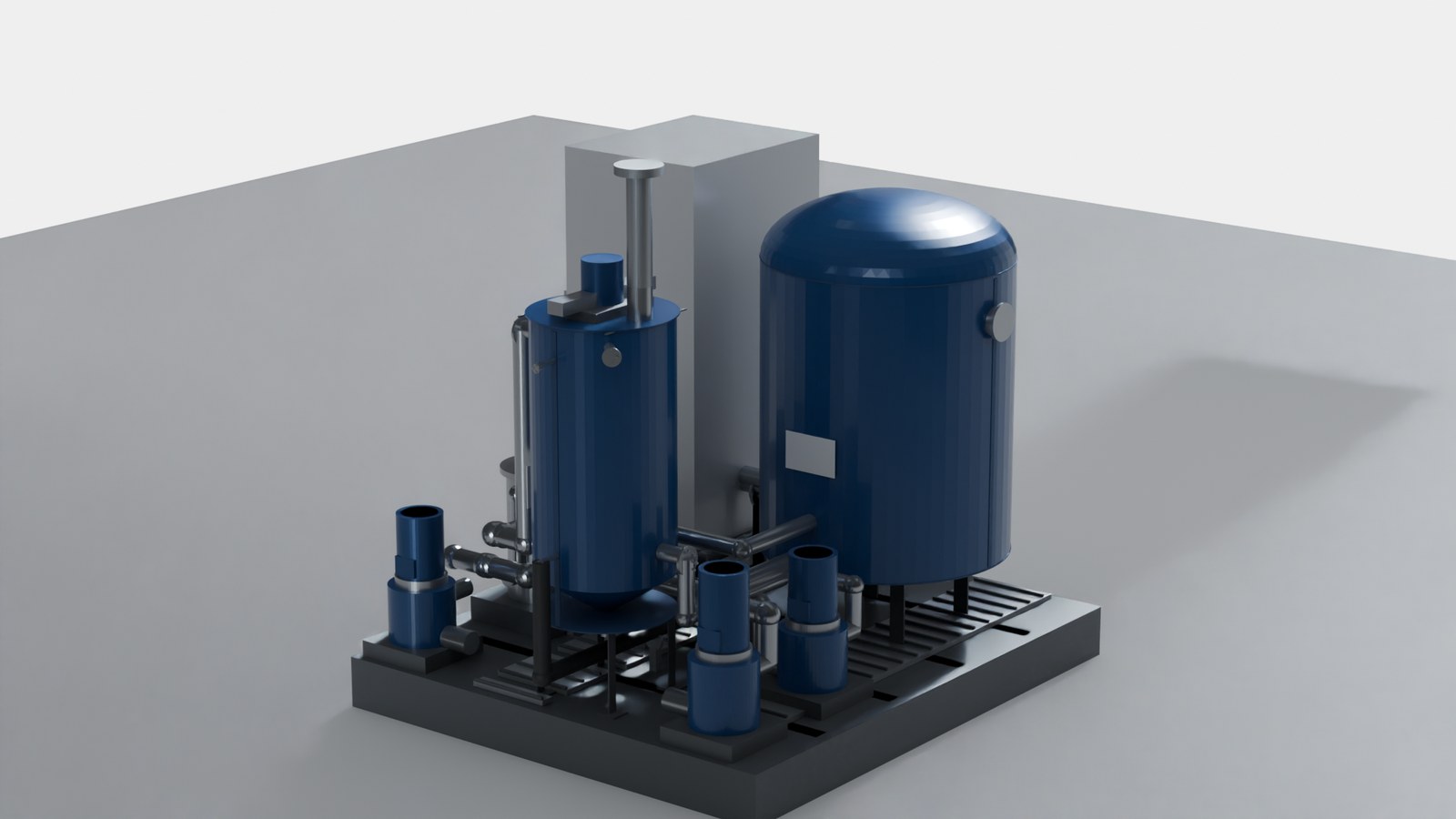
JT-ECT-330 skid-mounted electrochemical circulating-water descaling system · 3D general arrangement (modelled to the issued delivery drawings; illustration only)
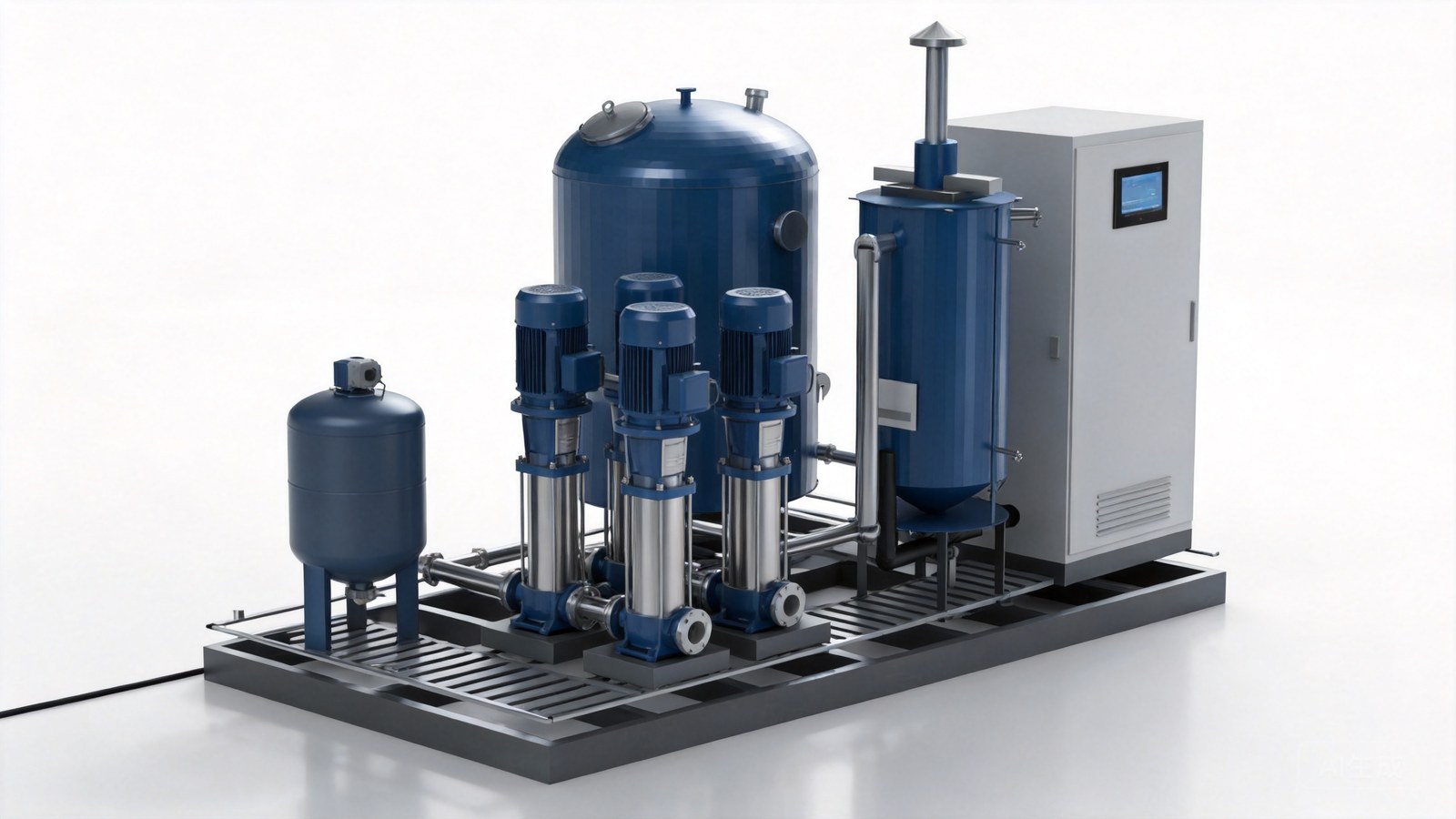
Illustrative rendering · AI-generated, not the actual unit; the issued drawings and the delivered equipment prevail
| Item | JT-ECT-330 | JT-ECT-500 | JT-ECT-1000 |
|---|---|---|---|
| Circulating water flow | 297 ~ 363 m³/h | 450 ~ 550 m³/h | 900 ~ 1100 m³/h |
| Side-stream flow | 20 m³/h pump duty/standby |
30 m³/h pump duty/standby |
60 m³/h pump duty/standby |
| Inlet / outlet connection | DN80 | DN100 | DN150 |
| Cell dimensions (dia. × H) | DN650 × 2,043.6 mm | DN850 (height per the final drawing) | φ1,012 × approx. 3,600 mm |
| Skid envelope and site footprint | Per our skid general-arrangement drawing | ||
| Cell weight (empty / operating) | 283 / 675 kg | 594 / 1,471 kg | approx. 1,040 / 3,160 kg |
| Power supply | 380 V / 50 Hz | 380 V / 50 Hz | 380 V / 50 Hz |
| Cell installed power (excl. pumps) | approx. 3.0 kW | approx. 4.2 kW | approx. 5.0 kW |
| Operating energy | approx. 3.01 kWh/kg CaCO₃ (operating basis; design condition 2.47) | ||
| Control system | Siemens S7-1200 PLC + 7-inch HMI + 4G remote; 14 instrument tags | ||
| Scale removal | Rotating mechanical scraper, once every 2 h for about 20 s; no polarity reversal or chemical cleaning | ||
| Installation | Outdoor skid, no plant room; requires compressed air 0.4-0.6 MPa and a blowdown connection to the plant drain | ||
| Materials | Vessel Q245R (wall for corrosion protection only); anode plates TA2 + IrO₂-Ta₂O₅, double-sided, Ir ≥3.0 g/m² per face; cathode plates 316L (Ir ≥ 6 g/m²) | ||
Skid approx. 2.0 × 3.4 m (≈6.8 m²); recommend reserving ≥3.5 × 5.0 m (maintenance & tie-in). Outdoor skid, no dedicated building; connect to the nearest circulating-water main.
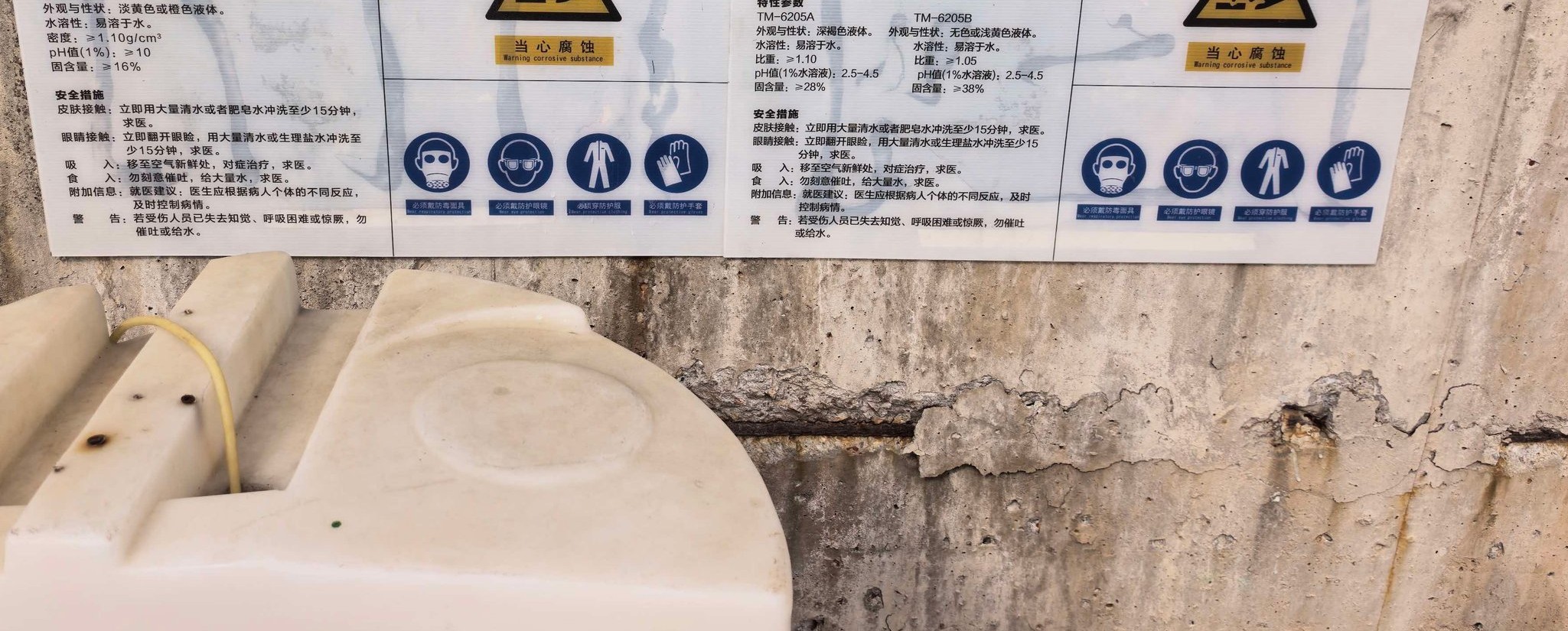
Chemical dosing station on site (oxidising biocide + scale/corrosion inhibitor) — the electrochemical unit can be installed nearby to replace continuous dosing
A large grain & oil processing plant: two cooling-tower cells, 330 m³/h total ⇒ select 1 × JT-ECT-330 (covers 297–363 m³/h).
Water quality and operating conditions vary by industry. We can provide application-specific technical documentation for individual projects.
Full calculation from your make-up water quality: mass balance, Faraday calculation, equipment sizing — delivered as a calculation sheet plus shop drawings. Most competitors hand over a brochure.
We will tell you plainly when electrochemical treatment is not recommended. Claims such as '95% scale inhibition' or '80% chemical saving' are common in this industry; we do not use unverifiable figures.
Shop drawings, calculations and inspection criteria for the first JT-ECT-330 are open to item-by-item review.
From sizing to commissioning you deal with the engineer who made the design, not a call centre. Fast answers and decisions.
Circulating flow or cooling tower model, make-up water quality (calcium hardness, total alkalinity, chloride, TDS) and site conditions.
Recalculated from your water quality: sizing result, scope list and energy consumption, with the assumptions stated.
Applicable conditions, cost basis and what can and cannot be achieved — before deciding whether to proceed.
Confirm the side-stream tapping point, pipe connections, power and air supply, location and footprint.
Supplied and commissioned as one package; on-site operation and safety follow your procedures.
Remote data, guidance on periodic sludge removal and anode inspection, control parameters adjusted to actual operation. 2-year warranty on the complete unit and on anode plates; response within 4 h and on-site within 48 h; service base: Wuxi; spare parts supplied within 2 weeks.
Takes about one minute. An engineer will call you to understand the actual site conditions before we propose anything.
Under normal operating conditions no scale/corrosion inhibitor or biocide is dosed. During commissioning, or under abnormal conditions such as sharp water-quality swings, temporary dosing may still be required per site procedure — we do not claim it is never needed. The applicable envelope is stated in the sizing calculation.
The electrochemical process lowers calcium hardness and total alkalinity simultaneously and in equal amounts, so cycles of concentration can be raised to the LSI control limit and blowdown drops substantially. The achievable value depends on make-up water quality, system heat load and dosing history; it must be recalculated per site.
About 2.47 kWh per kg CaCO₃ at design conditions (cell voltage 4.616 V); on an operating basis — actual operating power against the design descaling capacity of 154 g/h — about 3.01 kWh per kg CaCO₃. Actual consumption depends on water quality, heat load and operating strategy; the figure for a specific project is stated in our calculation sheet.
Outdoor skid-mounted; no dedicated plant room. It requires floor space, a compressed-air supply and power. Where no air supply exists, a mobile compressor can be supplied.
Not all at once. Typically the two run in parallel for a period (chemical dosing kept as back-up) until water quality is stable, then dosing is phased out. The switch-over schedule can follow your production plan.
The cooling tower nominal flow is enough for a preliminary match; further data (make-up water quality, site conditions) is confirmed together with our engineer. Detailed sizing is issued by us as a calculation sheet.
Want a recommendation for your case?
Fill the 30-second duty form (flow, main problem, contact). We reply with a tailored technical note.